


10 Clauses Every Independent Contractor Agreement Should Include Don’t Start From a Blank Page A...
How to Write an Independent Contractor Agreement (Step-by- Step Guide)
Most businesses don't fail because they hire contractors. They fail because they never formalized the relationship properly.A handshake agreement or email thread won't protect you when the contractor claims employee status, disputes payment terms, or says they own the work they created. This guide walks through how to structure a contractor agreement that protects both sides, survives legal scrutiny, and prevents disputes before they start.
Why Agreements Matter
Contractor agreements aren't formalities. They're evidence of intent, scope, ownership, and relationship structure.
When the IRS or DOL audits your worker classification, they'll ask for your agreements first. When a contractor claims they own the logo they designed, your agreement determines who wins.
Real-World Example: A SaaS startup hired a developer on a handshake deal to build their MVP. Six months later, the developer claimed ownership of the codebase and demanded equity to transfer rights. No written IP assignment existed. The startup paid $15,000 to settle and nearly lost their funding round.
Contractor Agreement Template
Don't Start from a Blank Page
A contractor agreement isn't just documentation --- it's your first line of defense against misclassification audits, IP disputes, and payment conflicts.
Essential protections • Easy to customize • Attorney-drafted
The Core Structure of an Independent Contractor Agreement
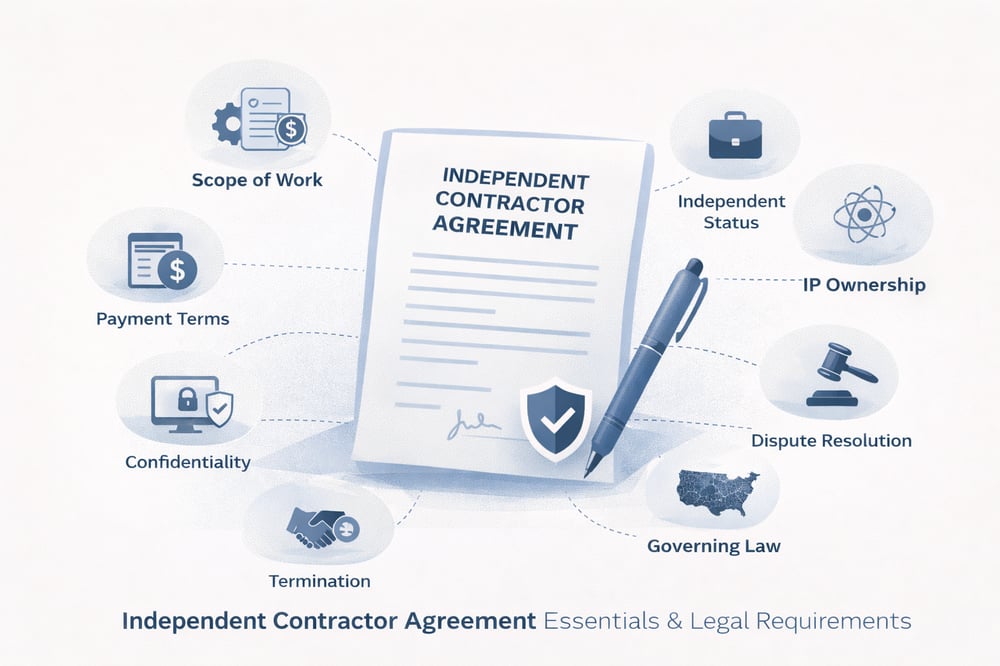
Every defensible contractor agreement includes these nine essential clauses. Miss one, and you're creating exposure.
| Clause | What It Covers |
|---|---|
| Scope of Work | Specific deliverables, deadlines, and acceptance criteria. Vague scope invites disputes and scope creep. |
| Payment Terms | Fixed fee, milestones, or hourly rate with caps. Include invoice requirements and payment timeline (net 15, net 30). |
| Independent Status | Explicit language that contractor controls methods, tools, and schedule. States contractor is not an employee. |
| IP Ownership | Clear assignment of work product to the company. Default rule: contractor owns what they create unless transferred. |
| Confidentiality | Protects proprietary info, trade secrets, and client data. Essential for any contractor with system access. |
| Termination | Notice period, termination for cause, and final payment terms. Prevents drawn-out exits. |
| Indemnification | Contractor assumes liability for their work, errors, and legal claims arising from their actions. |
| Dispute Resolution | Arbitration or mediation clause. Keeps conflicts out of court and reduces legal costs. |
| Governing Law | Which state's laws apply. Critical for multi-state contractors or remote work. |
These aren't optional. Each clause serves a specific legal and practical function.
Common Drafting Mistakes (and How to Avoid Them)
Most contractor agreement failures stem from four recurring errors. Here's what experienced practitioners watch for:
Mistake #1: Over-Controlling the Contractor
The fastest way to turn a contractor into an employee is to control their schedule, methods, and daily tasks. If your agreement dictates work hours, required tools, or approval processes for routine decisions, you're creating an employment relationship regardless of what the contract says.
Mistake #2: Missing or Weak IP Assignment Clause
Default copyright law gives creators ownership of their work. If your contractor builds your website, designs your brand, or writes your code without a clear IP assignment, they own it --- not you. Always include explicit language transferring all work product and intellectual property rights to your company.
Mistake #3: Vague Scope of Work
Phrases like "provide marketing support" or "assist with development" create confusion and invite scope creep. Define specific deliverables, deadlines, and acceptance criteria.
Mistake #4: Copy-Pasting Employee Policies
Contractors aren't employees. Don't include employee handbook language, PTO policies, or benefit references. Every employee-like provision weakens your independent contractor classification.
Pro Tip: Before finalizing any contractor agreement, review our Contractor Agreement Checklist to catch common gaps and ensure complete coverage.
Compliant Agreement Builder
Build a Contractor Agreement That Holds Up
Generate a compliant independent contractor agreement with all nine essential clauses, proper IP assignment, and state-specific protections.
All essential clauses • IP protection • Misclassification safeguards
State-by-State Variations (Cautionary Note)
Not all contractor agreements work nationwide. States like California, Massachusetts, and New Jersey apply stricter classification tests that can override even well-drafted agreements.
California's ABC test presumes every worker is an employee unless you prove otherwise. Massachusetts requires contractors to carry workers' comp insurance in certain industries. New Jersey mandates business registration for many contractor relationships.
Real-World Examples
Example #1 --- Marketing Consultant IP Dispute
A boutique agency hired a freelance copywriter to develop brand messaging for a major client pitch. No written agreement existed. The agency won the client, used the messaging for two years, then received a cease-and-desist from the copywriter claiming copyright ownership.
The agency paid $22,000 to acquire rights they assumed they already owned. A simple IP assignment clause would have prevented the entire dispute.
Example #2 --- Software Developer Control Issue
A fintech startup hired a "contractor" developer for a six-month project. The company assigned daily tasks, required attendance at morning standups, and provided company equipment. When the engagement ended, the developer filed for unemployment benefits.
The state ruled the relationship was employment, not independent contracting. The company owed back payroll taxes and unemployment insurance on six months of payments.
Compliance Checklist
Use this checklist to verify your contractor agreements meet minimum legal standards:
- Written contract signed by both parties before work begins
- Clear "no employee" language and independent status confirmation
- Defined deliverables, deadlines, and acceptance criteria
- Explicit ownership transfer of all work product and IP rights
- Contractor controls methods, tools, and schedule
- Separate tax and insurance responsibilities stated clearly
- Termination provisions including notice period and final payment
- Confidentiality protections for proprietary information
- Dispute resolution mechanism (arbitration or mediation)
If you can't check every box, your agreement needs revision before the contractor starts work.
Build Your Independent Contractor Agreement
Create a compliant contractor agreement in minutes --- with all nine essential clauses, IP protection, and misclassification safeguards built in.
Attorney-drafted • State-compliant • Ready to customize
FAQs: Independent Contractor Agreements
Final Thought
A solid contractor agreement is less about protection and more about clarity --- it prevents fights before they start. Templates give you structure, but they're starting points, not guarantees.
Customize every agreement to match the specific engagement, verify your behavior aligns with the terms, and document your reasoning. When disputes arise, regulators and courts won't ask what you intended --- they'll ask what you wrote and how you acted.
Build Contracts That Hold Up
Create, customize, and manage independent contractor agreements with the clauses, safeguards, and structure real disputes are decided on. SMVRT Legal combines attorney-drafted templates with practical compliance guidance — all in one platform.
Explore SMVRT Legal →
.png?height=200&name=svgviewer-png-output%20(2).png)
