

How to Write an Independent Contractor Agreement (Step-by- Step Guide) Most businesses don't fail...
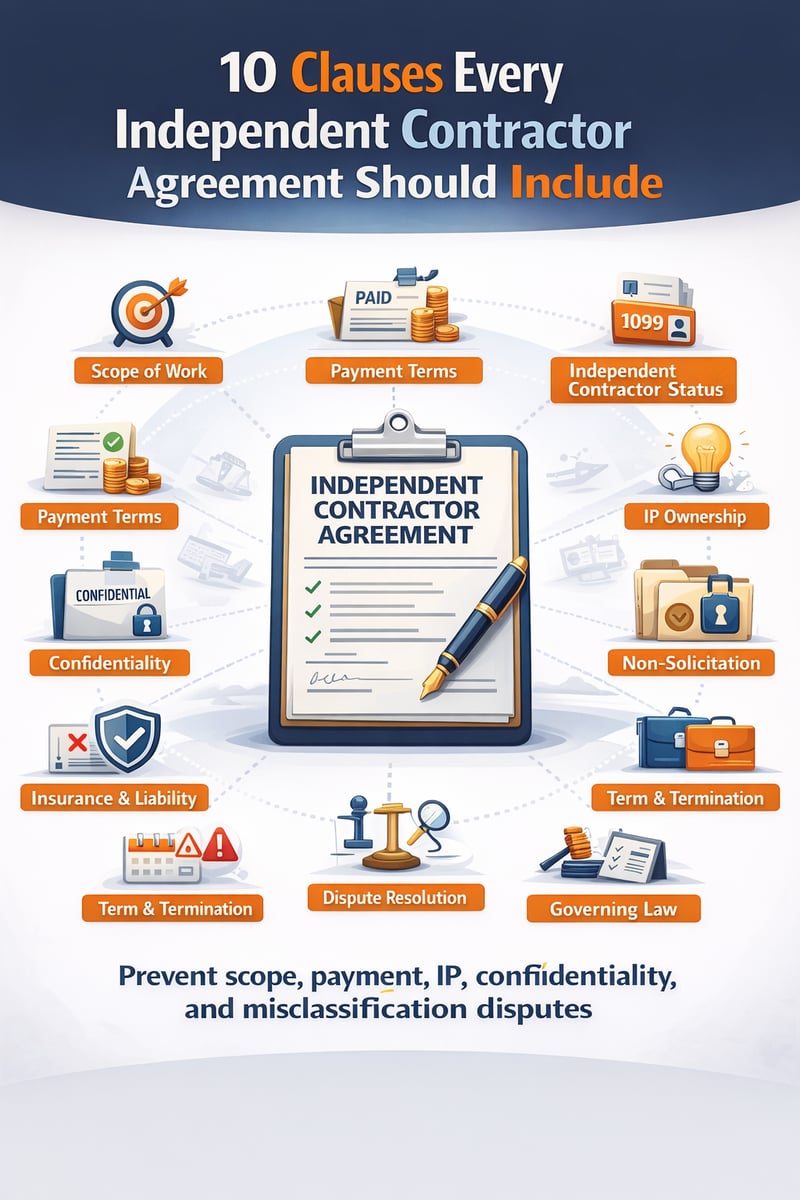
10 Clauses Every Independent Contractor Agreement Should Include
Don’t Start From a Blank Page
A contractor agreement should do more than “confirm 1099 status.” It should define deliverables, lock down IP ownership, control confidentiality, set payment triggers, and give you a clean exit if things aren’t working.
Use a properly drafted Independent Contractor Agreement to start with the right structure — then customize the clauses below to match the reality of the working relationship.
Most independent contractor agreements look acceptable until they’re tested. The test is rarely dramatic. It’s usually a predictable dispute: scope creep, late payments, a broken relationship, or an “I thought I owned that” moment after the work is delivered.
Here’s the key point most templates miss: a defensible agreement isn’t defined by the label “independent contractor.” It’s defined by whether the contract answers the questions that come up when incentives change. People get reasonable until the relationship ends. Your clauses need to work in that phase, too.
Jump to:
- Key Takeaways
- Required vs Recommended Clauses
- Quick Reference Table
- Clause 1: Scope of Work
- Clause 2: Payment Terms
- Clause 3: Independent Contractor Status
- Clause 4: Intellectual Property Ownership
- Clause 5: Confidentiality
- Clause 6: Non-Solicitation
- Clause 7: Insurance & Liability
- Clause 8: Term & Termination
- Clause 9: Dispute Resolution
- Clause 10: Governing Law
- Common Drafting Mistakes
- State-by-State Variations
- Quick Compliance Checklist
- FAQs
Key Takeaways
- Clarity beats length. The best agreements are precise about scope, payment triggers, and ownership — not padded with filler.
- IP ownership is not automatic. Contractors typically own what they create unless rights are assigned in writing.
- Misclassification risk is behavioral. The contract helps, but your day-to-day control matters more than your paperwork.
Required vs Recommended
Required (in practice): scope, payment terms, contractor status, termination, and governing law / dispute handling. These are the clauses that get “stress-tested” first.
Required if you have exposure: IP ownership (if work product is created), confidentiality (if sensitive information is shared), and risk allocation (if the work can cause real harm).
Quick Reference: The 10 Clauses and What Breaks Without Them
| Clause | What it controls | What breaks if it’s missing |
|---|---|---|
| 1) Scope of Work | Deliverables, boundaries, assumptions, revisions | Scope creep, quality disputes, “that wasn’t included” fights |
| 2) Payment Terms | Price, timing, invoicing, late fees, expenses | Nonpayment claims, leverage battles, “I’m not paying for this” stalemates |
| 3) Independent Contractor Status | No benefits, no withholding, no employment relationship | Confusion, inconsistent treatment, weak evidence in classification disputes |
| 4) IP Ownership / Assignment | Who owns work product, derivatives, source files | Contractor claims ownership; business can’t use or sell what it paid for |
| 5) Confidentiality | What is confidential, how it can be used, survival period | Information leaks with no clean remedy |
| 6) Non-Solicitation | Preventing poaching of clients/employees (narrowly) | Revenue loss and relationship damage; unenforceable “non-compete” overreach |
| 7) Insurance & Liability | Coverage expectations, risk allocation, claims handling | Everyone argues about responsibility after a loss |
| 8) Term & Termination | Start/end dates, termination rights, wind-down obligations | Messy breakups, unfinished work, payment and access disputes |
| 9) Dispute Resolution | Forum, process, costs, attorney’s fees | Expensive litigation by default (often in the wrong state) |
| 10) Governing Law | Which state’s laws apply | Unpredictable outcomes; extra cost fighting about where to fight |
Clause-by-Clause Breakdown
Clause 1: Scope of Work (This is Where Disputes Start)
Scope is more than a paragraph that says “Contractor will provide marketing services.” Good scope drafting defines deliverables, revision limits, dependencies, and what is expressly out of scope.
- Say what “done” means. Approved mockups? A deployed feature? A signed-off campaign?
- Limit revisions. “Two revision rounds” is better than “as needed.”
- Define dependencies. If the business doesn’t provide access, materials, or feedback, timelines move.
Common drafting mistake: vague scope plus hourly billing. That combination invites frustration: the business feels “nickel-and-dimed,” and the contractor feels “expanded without pay.”
Clause 2: Payment Terms (Define Triggers, Not Just Rates)
Payment clauses should answer: what gets paid, when it’s due, how invoicing works, and what happens if payment is late. Experienced drafters focus on triggers: what event makes payment due.
- Milestone payments (recommended for project work): deposit + defined milestones + final acceptance.
- Hourly work: require written approval for time caps and change requests.
- Expenses: specify which expenses are reimbursable and whether pre-approval is required.
Common drafting mistake: “Payment due upon completion” without defining completion or acceptance. That becomes leverage warfare.
Clause 3: Independent Contractor Status (Useful, But Not Magic)
This clause should confirm the contractor controls their methods, tools, and schedule — and that the business does not provide benefits or withhold taxes. It’s necessary evidence, but it won’t save you if your behavior contradicts it.
Practical drafting note
Include language that the contractor may perform services for others, supplies their own tools, and is responsible for taxes and insurance. Then operationally behave the same way.
If you’re unsure where the classification line is, review our 1099 vs W2 worker classification guide — and for federal context, see the IRS overview of worker classification factors.
Reference (external): IRS — Independent contractor defined
For a solid baseline structure (scope + payment + contractor status + IP), start with our Independent Contractor Agreement template and tailor the operational details to match how the relationship actually runs.
Clause 4: Intellectual Property Ownership (The Most Expensive Omission)
This is where small businesses get burned. Contractors generally own what they create unless rights are assigned in writing. If your contractor is creating code, designs, content, workflows, SOPs, or brand assets, you need clear ownership language.
Real-world scenario: A marketing consultant builds a high-performing ad account structure and creative library. The relationship ends. Without an IP assignment and handoff obligations, the business can’t confidently reuse, modify, or transfer those assets — and sometimes loses access entirely.
- Assign ownership of work product upon creation or payment (be explicit).
- Cover pre-existing materials (contractor tools, templates) with a license if needed.
- Require delivery of source files and credentials at completion or termination.
If ownership matters, pair your contractor agreement with an IP Assignment Agreement.
Clause 5: Confidentiality (Define It Like You Mean It)
Confidentiality clauses fail when they’re either too vague (“everything is confidential”) or too narrow (only a short list). Strong drafting defines categories of confidential information, sets permitted uses, and clarifies survival after termination.
- Define confidential information by category (pricing, client data, strategies, product plans, code, SOPs).
- Include exclusions (public info, independently developed info, info received lawfully from others).
- State the purpose: information may be used only to perform services under the agreement.
If you’re exchanging sensitive info before the relationship starts, use an NDA.
Clause 6: Non-Solicitation (More Enforceable Than “Non-Compete”)
Many businesses instinctively reach for a non-compete. In many states, that’s risky or unenforceable — especially for contractors. A narrow non-solicitation clause is often the smarter move: it protects customer relationships without trying to block someone’s livelihood.
Practical drafting note: Limit duration and scope. Tie it to customers the contractor actually interacted with, not your entire market.
Clause 7: Insurance & Liability (Risk Allocation Without Theater)
If a contractor’s work can cause real harm — financial loss, third-party claims, security exposure — you want to address risk upfront. The clause may require proof of insurance (general liability, professional liability, cyber coverage) and describe indemnification.
- Insurance requirement: specify coverage type and minimum limits when appropriate.
- Indemnification: allocate responsibility for third-party claims tied to a party’s negligence or breach.
Common drafting mistake: one-sided “contractor indemnifies for everything” language that doesn’t match leverage or reality. Courts and counterparties often push back hard.
Clause 8: Term & Termination (Plan the Breakup)
Termination clauses should cover: termination for convenience, termination for cause, notice periods, and what happens to unfinished work. If you don’t plan the exit, you end up paying extra just to regain access to work product and accounts.
Real-world scenario: A software developer has admin access to repositories and third-party tools. The relationship ends abruptly. Without handoff language and a post-termination cooperation requirement, the business scrambles to secure systems and continue development.
Clause 9: Dispute Resolution (Avoid Defaulting Into the Wrong Fight)
This clause decides whether disputes go to court, arbitration, or mediation — and where. It also decides who pays attorney’s fees. Businesses often ignore this until they realize they’re being sued across the country.
- Venue and jurisdiction: pick a practical location.
- Attorney’s fees: decide whether the prevailing party recovers fees.
- Escalation step: mediation before litigation can save real money.
Clause 10: Governing Law (The “Which Rules Apply?” Clause)
Governing law clauses are not filler. Contractor rules differ by state — especially around restrictive covenants, contractor tests, and what remedies are available. Pick governing law intentionally, then ensure your restrictive covenants and worker classification posture still make sense.
Common Drafting Mistakes (and a Fast Self-Audit)
Here’s what I see most often when contractor agreements go wrong: (1) vague scope, (2) fuzzy payment triggers, (3) missing IP assignment, and (4) termination clauses that don’t force a clean handoff.
If you want a quick, practical audit of what’s missing, use this checklist: 👉 Contractor Agreement Checklist
State-by-State Variations (Cautionary Note)
If you have contractors in multiple states, you should assume one agreement will not fit perfectly everywhere. States like California, Massachusetts, and New Jersey apply stricter worker-classification tests and may restrict certain contract terms (especially broad restrictive covenants).
Practical point
The contract is evidence — but classification is ultimately judged by how the relationship operates day to day (control, tools, schedule, economic dependence). Draft for the reality you’re creating.
Quick Compliance Checklist (If You Only Do Five Things)
- Define deliverables, revision limits, and what “acceptance” means.
- Use clear payment triggers (deposit + milestones beats “upon completion”).
- Assign IP ownership and require source-file/credential handoff.
- Include confidentiality with practical definitions and survival language.
- Plan termination: notice, wind-down, access, and payment for completed work.
Final Thought
A strong contractor agreement isn’t about sounding “legal.” It’s about making the relationship predictable: what gets delivered, what gets paid, who owns the work, what stays confidential, and how the engagement ends. Templates are a starting point. The clauses — drafted with real-world disputes in mind — are what protect you.
Discover Smarter Legal Solutions
Build, review, and manage your business contracts with confidence. SMVRT Legal brings attorney-reviewed templates, compliance tools, and real legal guidance together in one platform.
Visit SMVRT Legal →