
.png?width=50&name=Brittany_Somerville%20(230x230).png)


What to Look Out for Before Signing a Master Service Agreement Quick Summary: MSAs often shift...
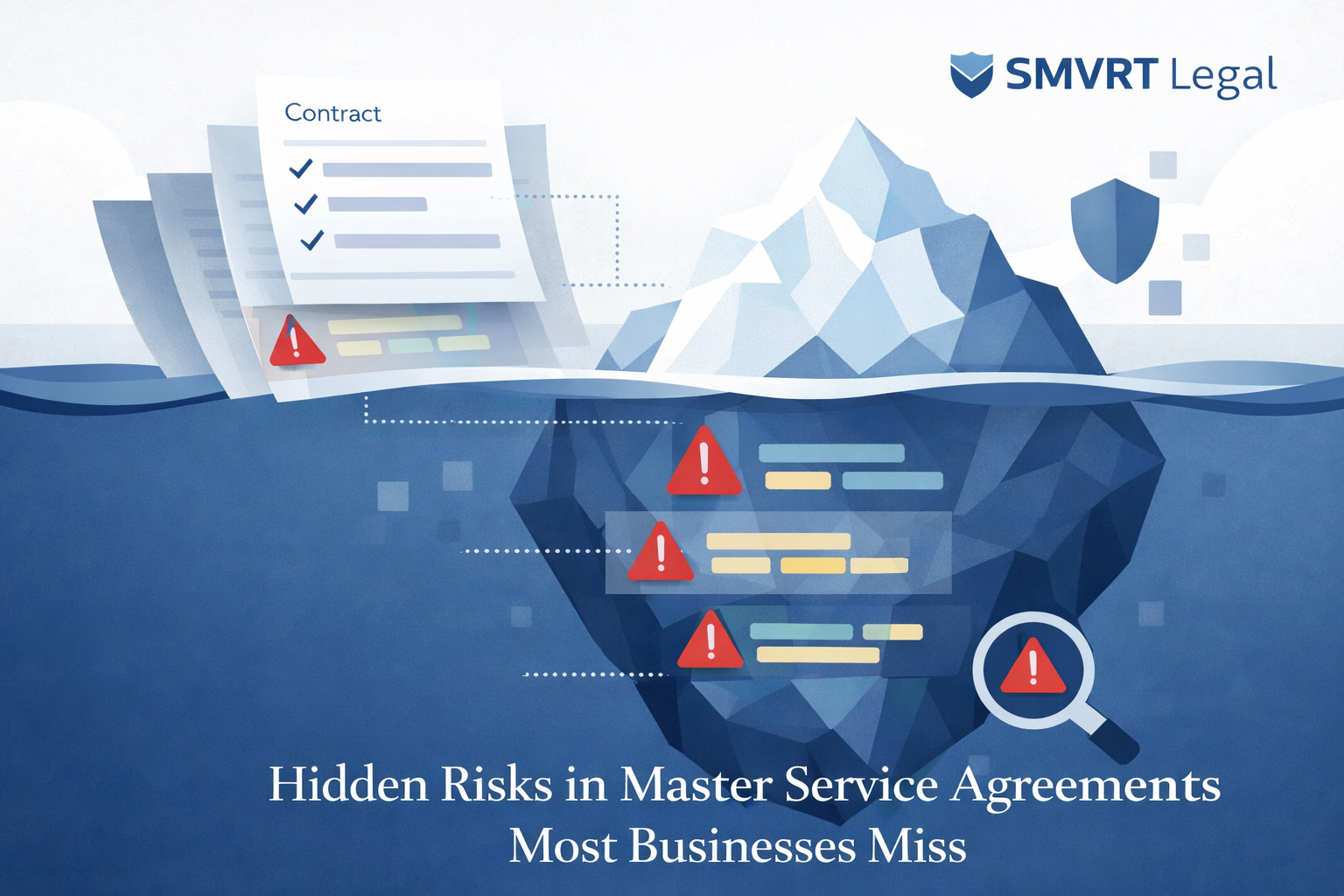
Hidden Risks in Master Service Agreements Most Businesses Miss

Quick Summary:
- Many MSA risks don't look risky at first — they sound reasonable until triggered.
- "Standard" language often shifts liability quietly in ways most businesses miss.
- Risk compounds across SOWs and time, creating multiplicative exposure.
- Problems surface only after disputes begin, when options narrow dramatically.
- Awareness beats renegotiation after signing — visibility is leverage.
- Run a Contract Risk Review to identify hidden risk, prevent compounding exposure, and protect your leverage before it’s too late
The biggest risks in Master Service Agreements aren't hidden because they're complex. They're hidden because they sound normal.
Most businesses approach MSA review looking for obvious red flags — unlimited liability, missing termination rights, grossly one-sided terms. But the truly dangerous clauses are the ones that seem reasonable at signature and catastrophic six months later.
This isn't about bad faith or aggressive counterparties. It's about risk allocation that favors the drafting party by default, compounds across multiple engagements, and triggers in ways most businesses don't anticipate.
Why MSA Risks Are Easy to Miss
Smart businesses overlook MSA risks for structural reasons, not because they're careless. The very systems designed to streamline contracting — template reuse, procurement standardization, legal review fatigue — create blind spots.
Template reuse means you're starting from the vendor's preferred position every time. Their template optimizes for their risk profile, not yours.
Procurement teams normalize what they see repeatedly. "Everyone signs this" becomes validation rather than a warning signal.
Legal teams, reviewing their fiftieth MSA of the quarter, develop pattern fatigue and miss subtle variations that shift risk. Meanwhile, business teams focus on Statement of Work details and assume the MSA is handled.
The most dangerous assumption is that silence equals safety. When a clause doesn't trigger immediate objections, it feels acceptable — but master service agreement risks often lie dormant until circumstances change.
"Familiarity isn't validation — it's how risk hides in plain sight."
Risk #1 — Scope That Expands Without Compensation
The most financially damaging MSA risk is scope creep formalized in contract language. When an agreement defines services vaguely or allows the client to request work outside defined SOWs, you've transferred scope control — and with it, compensation control.
Common scope expansion triggers:
- "Services as reasonably requested" language
- Undefined support obligations
- Verbal or email-based scope modifications
- Missing change-order mechanisms
Without clear limits on what's included versus what requires a change order, clients can request work and frame it as part of the existing agreement. Refusing feels like poor service even when you're technically right.
Undefined support obligations create similar exposure. "Reasonable support" or "assistance during implementation" sound collaborative but create open-ended commitments with no defined endpoints or triggers for additional payment.
Red Flag
⚠️ Vague scope language transfers pricing power to the client. If the MSA doesn't define what's included and what requires additional payment, you're working under their interpretation, not yours.
Risk #2 — Indemnification That Exceeds Fault
Indemnification clauses in MSAs often create asymmetric liability where you pay for problems you didn't cause. The difference between "arising from" and "relating to" determines whether you're liable only for your actions or anything connected to the engagement.
Most vendor templates choose "relating to" — shifting risk dramatically in their favor.
"Duty to defend" provisions make this worse. They require you to pay the client's legal fees from the first demand letter, regardless of merit.
Indemnity carve-outs from liability caps eliminate the protection you thought you had. Many MSAs include overall liability limits, but then carve out indemnification obligations from that cap — making your "limited" liability unlimited for any claim the client can frame as indemnifiable.
One-way indemnification completes the imbalance. You indemnify the client for anything "relating to" your services, while they don't indemnify you for anything — even when they misuse your deliverables or make false representations about your work.
Example: You deliver software. The client integrates it without following your implementation requirements, and a data breach occurs due to their configuration errors — but under "relating to" indemnification, you're liable because the breach relates to your software even though your code wasn't the cause.
Understanding why your "standard" Master Service Agreement may be putting you at risk starts with recognizing how these indemnification provisions interact with other clauses to create systemic exposure.
Risk #3 — IP Ownership That Sweeps Too Broad
Intellectual property provisions in MSAs often transfer more than the specific deliverables you're being paid to create. "Work made for hire" language, "in connection with" clauses, and timing-based capture can sweep up pre-existing IP, tools, methodologies, and future innovations.
"Work made for hire" is frequently misapplied in MSA contexts. Under copyright law, true work-for-hire requires an employment relationship or specific categories of commissioned work — but many MSAs declare everything "work made for hire" without meeting statutory requirements.
"In connection with" language extends ownership beyond deliverables. If the MSA states the client owns all IP "created in connection with" the services, that captures your internal tools, templates, and processes used during delivery.
Timing-based IP capture is equally problematic. Clauses stating the client owns "all IP created during the term of this agreement" don't distinguish between project-specific work and unrelated innovations.
"IP risk doesn't appear in the project — it surfaces when you try to use your own work elsewhere."
The solution isn't refusing all IP transfer — it's defining exactly what transfers. Deliverables created specifically for the client under an SOW should belong to them, while background IP, tools, templates, and generalized knowledge should remain yours.
Risk #4 — Termination That Breaks Cash Flow
Termination provisions in Master Service Agreements determine who absorbs financial shock when relationships end. Asymmetric termination rights — where clients can exit immediately but vendors face extended notice requirements — create structural exposure.
Immediate client termination without cause is common in vendor-drafted MSAs. "Client may terminate this agreement at any time with 30 days' notice" sounds reasonable, but if you're staffing a dedicated team or declining other work to meet their needs, 30 days isn't enough runway.
No pro-rata payment language means partial work goes unpaid. If an SOW is scoped for three months and the client terminates after six weeks, do they owe payment for work delivered — without explicit pro-rata terms, they'll argue no payment is due until deliverables are complete.
Surviving obligations post-termination extend exposure indefinitely. Indemnification, confidentiality, IP warranties, and non-solicitation often survive termination — you're no longer getting paid, but you're still on the hook for liability.
The hidden risk: Termination clauses aren't just about ending relationships cleanly. They're about who holds power when circumstances change — and MSA contract risks compound when termination rights are one-sided.
Risk #5 — Payment Conditions That Delay or Eliminate Pay
Payment provisions that seem straightforward often contain conditions that delay or eliminate payment entirely. "Satisfaction" requirements, pass-through clauses, unlimited offset rights, and missing late-payment penalties all shift financial risk onto the vendor.
Common payment risk mechanisms:
- "Payment upon client satisfaction" or "subject to client acceptance" creates subjective performance standards
- Pass-through payment clauses tie your payment to the client's receipt of payment from their customer
- Unlimited offset rights allow clients to withhold payment for any alleged issue
- No late-payment penalties eliminate consequences for slow pay
What constitutes "satisfaction" isn't defined, giving clients discretion to withhold payment indefinitely. Even if you've met every objective requirement in the SOW, they can reject deliverables for vague reasons and demand revisions without additional payment.
Pass-through clauses mean you're financing their receivables — if their customer pays in 120 days or never, you wait accordingly. You've taken on credit risk for a party you've never vetted.
💡 Payment risk is leverage risk. When clients control whether, when, and how much they pay, they control the relationship. Payment terms aren't administrative details — they're power structures.
Risk Reflection: Why These Don't Feel Risky
The MSA risks outlined above share a common characteristic — none of them trigger alarm bells during review. Scope flexibility sounds collaborative, indemnification seems standard, IP assignment appears fair, termination rights feel balanced, payment conditions look reasonable.
That's exactly why they're dangerous. Hidden MSA risks don't announce themselves as problematic — they position themselves as normal business terms, tested across thousands of agreements, refined by experienced counsel.
Most disputes don't start with obviously bad contracts. They start with clauses that seemed fine until a project that was profitable under the original scope becomes a loss when expansion work goes unpaid, or indemnification that felt abstract becomes concrete when a third party sues.
The pattern is consistent: Risk feels theoretical at signature and structural during disputes. By the time you understand how a clause works in practice, you're operating under its terms with limited recourse.
.png?width=340&height=351&name=Group%20427320551%20(1).png)
Find the Risk That Looks “Normal” in Your MSA
Hidden liability, compounding exposure across SOWs, and one-sided leverage rarely look dangerous at signature. A Contract Risk Review shows you where risk is quietly stacking before it becomes expensive.
👉 Run a Contract Risk ReviewWhy "Standard" Language Is Often the Problem
"Standard" Master Service Agreement language is standard because it's been tested, refined, and proven to favor the drafting party. When a vendor tells you "this is our standard MSA," they're signaling it's been optimized through multiple negotiations to allocate risk in their favor.
The psychology of "standard" creates pressure to accept terms without pushback. Questioning standard language feels unreasonable, as if you're asking for special treatment rather than appropriate risk allocation.
Incremental risk stacking is how standard terms evolve. Each negotiation, the drafting party pushes slightly further — broader indemnification, longer payment terms, more expansive IP transfer — and when the other side accepts, that becomes the new baseline.
Vendor normalization completes the cycle. As more companies accept imbalanced terms, those terms become industry norms — familiarity masquerading as fairness is how master service agreement risks proliferate.
"Standard means tested — not fair. It means the drafting party knows what they're getting."
How Risk Compounds Across Multiple SOWs
Master Service Agreements are designed for repeat engagements — one contract governing multiple projects over time. This creates multiplicative exposure as MSA legal issues compound across every Statement of Work.
Indemnification exposure stacks with each SOW creating new potential claims. By Project 10, you're carrying cumulative liability across multiple workstreams, all uncapped if indemnification carves out from overall limits.
IP leakage accelerates over time. The tools and methodologies you develop for Project 1 improve by Project 3 and become core differentiators by Project 7 — but under "in connection with" language, they all belong to the client.
Cumulative liability from payment conditions creates cash flow instability. Pass-through payment clauses mean you're financing receivables across all active SOWs simultaneously — if the client's customer pays slowly or faces financial distress, your exposure spans every project under the MSA.
The structural insight: MSA risks don't scale linearly. Each additional SOW increases total exposure more than the previous one because you're operating under accumulated obligations, broader IP transfer, and stacked liability.
What a Risk Review Actually Flags
An effective Master Service Agreement risk review doesn't just identify problematic clauses — it reveals how clauses interact to create systemic exposure. The relationship between indemnification, liability caps, IP ownership, and termination rights determines overall risk profile.
Risk hierarchy separates high-impact issues from noise. A risk review identifies which provisions create material exposure, which are industry-standard trade-offs, and which represent negotiation opportunities.
Enforceability analysis matters as much as wording. Some aggressive clauses are legally unenforceable in your jurisdiction but create dispute risk and negotiation leverage, while others are enforceable and dangerous.
Understanding when to have a lawyer review a Master Service Agreement becomes clear through professional risk assessment. Targeted modifications to high-risk provisions are often negotiable without creating deal friction.
💡 Risk reviews clarify what actually matters. Template checklists miss context. Professional analysis identifies where your specific business model intersects with contractual exposure — and where leverage exists to reduce it.
Master Service Agreement Review
Get Your MSA Reviewed by an Experienced Attorney
Don't sign contracts with hidden risk exposure. SMVRT lawyers identify problematic provisions, flag interaction effects, and clarify where negotiation reduces exposure without killing deals.
Risk assessment • Negotiation strategy • Predictable exposure
Frequently Asked Questions About MSA Risks
Final Thought
Hidden MSA risks aren't evidence of bad faith or aggressive negotiation. They're the natural result of contracts drafted to favor one party, tested across hundreds of engagements, and normalized through repeated acceptance.
Risk allocation in Master Service Agreements is structural, not accidental. Scope provisions, indemnification clauses, IP assignments, termination rights, and payment conditions all interact to create a system that determines who absorbs uncertainty.
Awareness is leverage. When you understand where hidden risks exist, you can negotiate targeted modifications that materially reduce exposure without creating deal friction — but when you don't, you're operating under someone else's risk framework without realizing the implications until circumstances force visibility.
Contracts are systems for allocating consequences. Master Service Agreements determine who bears the cost when projects expand, disputes emerge, IP questions surface, relationships end, or payment slows.
For comprehensive guidance on navigating these complexities, explore our MSA legal resource center covering everything from negotiation strategies to enforceability standards.

.png?width=50&name=Nancy%20Nassaka%20(310x310).png)