

Who Carries the Most Risk in a Master Service Agreement? Quick Summary: MSAs rarely allocate risk...
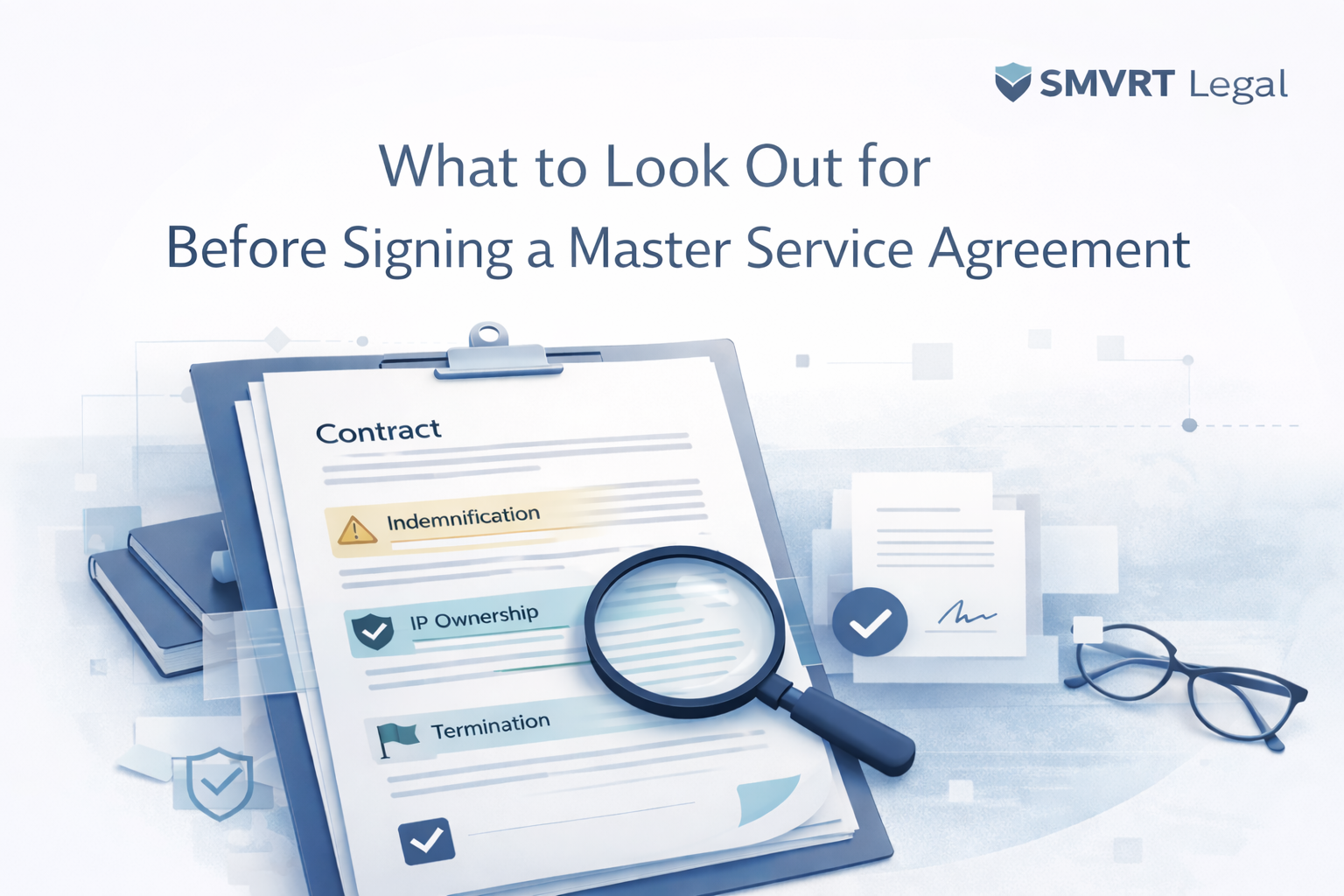
What to Look Out for Before Signing a Master Service Agreement

Quick Summary:
- MSAs often shift risk, liability, and payment terms without being obvious
- "Standard" MSAs frequently favor the party who drafted them
- The biggest risks hide in indemnity, scope control, termination, and IP
- A quick risk review can prevent expensive surprises after signing
- A professional contract review can identify indemnification exposure and other hidden liabilities before you sign
When a new client sends you their Master Service Agreement, it usually arrives with reassuring language. "This is our standard template." "We use this with all our vendors."
The implication is clear: this is routine paperwork standing between you and getting started. You open the document and see thirty-five pages of dense legal text with familiar-sounding section headings.
Nothing jumps out as obviously unfair. The language sounds like contracts you've signed before. So you skim through, maybe read a few key sections, and sign.
This is exactly when you're most vulnerable.
Most people don't realize there's a problem with their MSA until something triggers it. The client terminates unexpectedly and you discover you're not getting paid for work in progress. A third party files a lawsuit and suddenly you're on the hook for defense costs.
You try to reuse work you created and learn the client owns all the IP. A minor dispute turns into a major exposure because the indemnification clause is broader than you realized. By then, it's too late—the contract is signed and the terms control what happens next.
The most dangerous contracts are the ones that look familiar—because familiarity creates the illusion of safety. Before you sign your next Master Service Agreement, here's exactly what you need to look out for.
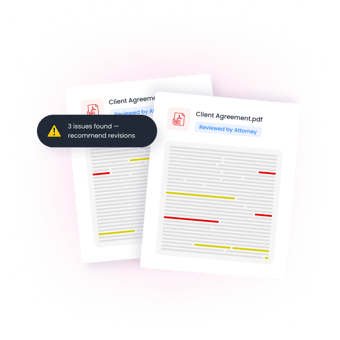
Before you sign, know exactly what you're agreeing to
Get a lawyer-led contract review that flags indemnity exposure, IP transfer risk, termination traps, and payment issues — before you commit.
👉 Review My MSA Before SigningWhat a Master Service Agreement Actually Controls
Before diving into specific risks, it's important to understand what makes MSAs different from typical contracts. A Master Service Agreement establishes the legal framework for an entire business relationship. Unlike a project-specific contract that governs one engagement, an MSA sets the rules that apply to every future transaction between you and the client.
The MSA defines the general terms—liability, indemnification, IP ownership, payment terms, termination rights, dispute resolution. Then you execute individual Statements of Work (SOWs) for specific projects. Each SOW operates under the MSA's umbrella terms.
This structure creates efficiency for ongoing relationships. You negotiate the legal terms once, then just define project scope and pricing in each SOW. But it also creates significant risk: a bad MSA compounds its damage across every project you take on.
If the MSA says the client can terminate immediately while you must give 90 days notice, that imbalance affects every single engagement. If it includes unlimited indemnification for "any claims relating to the services," your exposure multiplies with each new project. If it transfers all IP ownership broadly, you're giving away work product on every SOW you execute.
Over a three-year relationship with fifteen SOWs, a problematic MSA provision doesn't just create one problem—it creates fifteen opportunities for that problem to manifest. And because the MSA was signed at the beginning of the relationship, you have very limited ability to renegotiate once you've started work. This is why what you agree to before signing matters so much more with MSAs than with single-project contracts.
What to Look Out for Before Signing
Not every MSA provision creates equal risk. Some clauses are genuinely standard and protective. Others hide financial landmines behind familiar language.
Understanding key clauses in a Master Service Agreement helps you identify which provisions deserve careful attention. Here are the five risk categories that cause the most problems—and what to watch for in each.

A. Scope Creep Without Protection
One of the most insidious MSA risks is language that gives clients unlimited ability to expand your obligations without additional payment. The problem starts with vague scope language. When an MSA says you'll provide "services as reasonably requested by Client" or "support necessary to complete the work," it creates a trap.
The client can demand work outside your SOWs and argue it's covered under the master agreement. A consulting firm signs an MSA with broad service language, expecting clearly defined SOWs. Three months in, the client starts requesting "quick strategy calls," then "brief reviews" of unrelated materials, then "support" analyzing competitive research.
When the firm pushes back and requests compensation, the client points to the MSA's "services as requested" provision. The consultants are stuck choosing between unpaid work and potential breach of contract.
What makes this worse:
- No requirement for written SOWs: If the MSA allows verbal requests or email directives to constitute valid work orders, you have no paper trail proving what's in or out of scope
- Undefined "support" obligations: Terms like "reasonable assistance" or "cooperation" can expand indefinitely based on the client's subjective interpretation
- No formal change order process: Without a mechanism to document scope changes and adjust pricing, clients can add work without triggering additional payment
What to look for: Check whether the MSA requires all work to be defined in written, signed SOWs. Look for language that limits your obligations to what's specifically described in each SOW. Make sure there's a clear change order process for any requests outside the defined scope.
B. One-Sided Indemnification
Indemnification clauses determine who pays when something goes wrong. In many MSAs, they're also the most dangerous provisions—creating unlimited financial exposure for problems you didn't cause. The risk is in the breadth of language.
An indemnification clause that says you'll defend the client against "any and all claims arising out of or relating to the services" sounds reasonable at first glance. But that phrase "relating to" captures far more than just claims you caused. A marketing agency signs an MSA with this language.
Eighteen months later, their client gets sued by a third party over trademark issues in the client's core business operations—completely unrelated to anything the agency created. But opposing counsel argues the dispute "relates to" the marketing services because those services promoted the allegedly infringing brand. The court agrees, and the agency is now on the hook for six figures in defense costs.
Red flags in indemnification clauses:
- "Relating to" vs "caused by": The broader language can make you liable for tangentially connected claims, not just direct damages from your actions
- "Duty to defend" language: This means you pay the client's legal fees from day one of a claim—before any determination of fault or merit
- No caps on indemnity: Many MSAs limit liability for breach of contract but explicitly exclude indemnification obligations from those caps, creating unlimited exposure
- One-way indemnification: You indemnify the client, but they don't provide reciprocal protection for claims arising from their actions
What to look for: Check whether indemnification is limited to claims "directly caused by" your services or "arising from your negligence or willful misconduct." Look for mutual indemnification (both parties protect each other). Verify that indemnity obligations are subject to the same liability caps as other provisions.
C. IP Ownership That Isn't Clear
Intellectual property ownership provisions determine who owns what you create—and many MSAs transfer far more than most vendors realize. The trap is in the breadth of transfer language. An MSA might say "all work product and intellectual property created in connection with the services shall be owned exclusively by Client."
This sounds like it covers project deliverables. In practice, it can sweep in your proprietary methodologies, reusable templates, and internal tools. A software development firm builds a proprietary framework that accelerates their work across all clients.
They sign an MSA with broad IP language. Two years later, when they try licensing their framework to another company, their largest client threatens legal action—arguing the framework was "created in connection with" services under the MSA and therefore belongs to them.
Critical IP provisions to examine:
- "Work made for hire" language: This legal term transfers copyright ownership automatically. You retain no rights whatsoever to the work
- Timing-based language: Phrases like "created during the term" or "developed while performing services" can capture IP you build for internal purposes, not just client deliverables
- Connection-based language: "In connection with" or "related to the services" creates broad transfer rights beyond specific project work
- No background IP protection: Without explicit carve-outs for pre-existing tools, templates, and methodologies, the client might claim ownership of IP you brought into the relationship
What to look for: A balanced MSA distinguishes between project-specific deliverables (which the client can reasonably own) and your background intellectual property (which you license to them for their use). Look for explicit protection of your pre-existing IP, tools, and methodologies. Check whether "work made for hire" language applies only to specific deliverables or to everything you touch.
D. Termination That Leaves You Exposed
Termination provisions in MSAs are rarely balanced—and the imbalance creates devastating cash flow exposure when clients exercise their unilateral exit rights. The pattern we see constantly: "Client may terminate this Agreement at any time, for any reason, with or without cause, upon written notice. Service Provider may terminate only for cause or with 90 days advance written notice."
This creates multiple problems simultaneously. A design agency signs an MSA with these terms for a client representing 35% of their revenue. Eight months in, the client's leadership changes and the new CMO wants different vendors.
She invokes immediate termination. The agency has four projects in progress, about 60% complete. The MSA says payment is due "upon completion and acceptance of deliverables," so they receive nothing for work in progress—roughly $130K in unbilled time and expenses.
Termination risks to watch for:
- Asymmetric notice periods: Client can exit immediately while you're locked in for months, creating cash flow disasters and preventing you from replacing lost revenue
- No payment protection for work in progress: If payment requires "completion" or "acceptance," immediate termination can void payment for partially completed projects
- Surviving obligations: Confidentiality, non-solicitation, and indemnification duties often survive indefinitely—you stop getting paid but remain exposed to liability
- Post-termination payment risks: Language allowing clients to withhold final payment pending their satisfaction with all deliverables or resolution of any disputes
What to look for: Check whether termination rights are balanced (same notice period for both parties). Look for "pro-rata payment for services rendered" language that protects you if the client terminates mid-project. Verify which obligations survive termination and for how long.
E. Payment Terms That Hurt Cash Flow
Net-60 payment terms are aggressive. Net-90 is pushing reasonableness. But the real danger isn't the timeline—it's conditional payment language that gives clients indefinite control over when (or whether) you get paid.
Three examples that create serious problems:
- "Payment due within 60 days of Client's receipt of payment from end customer" — This makes you an unsecured creditor of your client's customer. If their customer doesn't pay or pays late, you absorb the consequences
- "Invoices payable upon Client's reasonable satisfaction with deliverables" — Without objective acceptance criteria, the client can withhold payment indefinitely by claiming subjective dissatisfaction
- "Client may offset any amounts Service Provider owes against amounts due" — This lets clients manufacture reasons to avoid payment by claiming you owe them money for unrelated issues
A vendor performs $320K in services over six months. When they submit invoices, the client claims the vendor breached a provision on a different project and offsets $240K against current invoices. The MSA permitted unlimited offset rights, so the vendor's only recourse is litigation.
Payment risks to identify:
- Pass-through payment risk: Your payment depends on the client's customer paying them, transferring their receivables risk to you
- Subjective satisfaction conditions: Payment contingent on vague "satisfaction" standards without objective criteria or dispute resolution
- Unlimited offset rights: Client can withhold payment for disputes unrelated to the current invoice
- No late payment consequences: Absence of interest charges or penalties means the client has zero financial incentive to pay on time
What to look for: Check whether payment is conditional on anything beyond your delivery of services and submission of proper invoices. Look for objective acceptance criteria in SOWs rather than subjective satisfaction standards. Verify that offset rights are limited to bona fide disputes related to the specific invoice.
⚠️ Important:
"Most MSA disputes don't come from bad behavior—they come from unclear risk allocation. A client invoking harsh contract terms isn't necessarily trying to harm you. They're just operating within the rights the MSA gave them."
Why 'Standard' MSAs Are Often the Most Dangerous
When someone calls their MSA "standard," they're not telling you it's fair or balanced. They're telling you something much more specific: "This is the version we've refined through experience to protect our interests, and most people sign it without meaningful changes."
Think about how these agreements get created. A company hires lawyers to draft an MSA that protects them from risk. They use it with vendors, and when problems arise, they add clauses to prevent those problems next time—from their perspective.
When vendors push back on certain terms, they figure out softer-sounding language that accomplishes the same protective function. Over time, the document becomes progressively more sophisticated at shifting risk away from whoever drafted it. What you eventually receive isn't a neutral starting point—it's a battle-tested instrument designed to protect the other party.
This works in both directions:
Vendor-drafted MSAs systematically limit vendor liability, create expansive warranties from clients, include aggressive IP protection for the vendor's work, and build in termination barriers. They call it "standard" because they use it with all customers.
Client-drafted MSAs do the opposite. They maximize vendor liability through broad indemnification, minimize client obligations, transfer IP widely to the client, and create unilateral termination rights. Large enterprises present these as "procurement policy" or "what legal requires," implying non-negotiability.
Neither version is "standard" in the sense of being balanced. They're standard in the sense that they represent the drafting party's optimal outcome, refined through experience to maximize their protection at your expense.
Why reused templates amplify risk:
When companies reuse the same MSA across dozens or hundreds of vendors, problematic clauses get embedded into standard practice. The procurement team stops questioning whether the terms are fair—they just know these are "the terms we always use." The more vendors who sign without pushback, the more entrenched the unfavorable provisions become.
This creates a dangerous feedback loop: other vendors' acceptance of harsh terms makes it harder for you to negotiate changes, even when those changes are completely reasonable. You're told "everyone else signs this" or "we can't make exceptions"—not because the terms are actually fair, but because the company has successfully gotten most vendors to accept them.
If you didn't draft it, you shouldn't assume it protects you. The MSA might look familiar because you've signed similar documents before—but familiarity doesn't mean safety. It just means other vendors before you also accepted terms that shifted risk away from the client.
Don’t sign blind
Upload your MSA for a fast, lawyer-led risk review and understand your liability, ownership, and termination exposure before it locks you in.
👉 Get My Contract Risk ReviewFast • No obligation • Clarity first
When You Should Absolutely Pause Before Signing
Not every Master Service Agreement requires extensive analysis. A short-term engagement with modest value and a trusted client might be safe to sign after basic review. Some relationships justify accepting higher risk.
But certain circumstances dramatically change the risk equation. When any of these factors apply, the cost of not understanding your contractual exposure can exceed the entire value of the relationship.
Pause before signing if you see:
- High dollar value: When the contract or expected revenue exceeds $100K, the financial stakes justify careful review
- Long-term relationship: MSAs designed for 3-5 years compound the impact of bad terms across dozens of engagements
- Automatic renewals: If the MSA auto-renews unless you provide 60-90 days notice, you might forget to exit and find yourself locked into another term
- Unlimited liability language: Any MSA with phrases like "any and all claims," "relating to," or "indemnification excluded from liability limitations"
- Multiple SOWs planned: If you expect to execute many statements of work, each one operates under the MSA's terms
- Your proprietary IP is involved: If you're using tools, frameworks, or methodologies you can't afford to lose
- Client represents significant revenue: When one relationship accounts for >20% of your income, termination and payment risks become existential
- New client or unfamiliar industry: Without track record or context, the contract might be your only protection
If even one of these circumstances applies, investing time in contract review before signing is essential. Once the MSA is executed, your leverage is gone. The only protection you have is whatever that contract provides.
What a Contract Risk Review Actually Helps You See
Reading 35 pages of legal text won't necessarily tell you what you need to know. Even if you understand legal terminology, it's easy to miss dangerous provisions when they're buried in complex clauses. A proper risk review identifies patterns that create real exposure.
1. Identifies hidden risk patterns
Dangerous provisions don't always announce themselves. "Relating to" vs "arising from" is a two-word difference with massive liability implications. "Work made for hire" is a technical legal term that transfers copyright ownership completely—but it looks like standard language if you don't know what it means.
2. Spots state-specific issues
Some MSA provisions that work in one state create problems in another. Choice of law and forum selection clauses can force you into unfavorable jurisdictions. Non-compete provisions enforceable in one state might be void in another.
3. Distinguishes clauses that matter from noise
Not every provision requires negotiation. Some standard terms genuinely are routine and protective. A risk review helps you focus your limited negotiation capital on provisions that create real exposure, rather than fighting battles over language that doesn't matter.
4. Shows whether action is actually needed
Sometimes an MSA is genuinely balanced and protective. Other times, the risks are significant but the opportunity justifies accepting them. A good risk assessment doesn't just flag problems—it helps you understand whether those problems require negotiation, additional protection (like insurance), or simply informed acceptance.
The goal isn't to make every contract perfect. It's to make sure you understand exactly what you're agreeing to before you commit—so you can make an informed decision about whether the opportunity justifies the risk.
Frequently Asked Questions
Lawyer-Led Contract Review
Know Your Risk Before It Becomes Your Problem
Upload your Master Service Agreement for a detailed risk review highlighting indemnification, IP ownership, termination, and payment exposure — with practical next steps.
Clear breakdown • Actionable insights • Delivered fast
.png?width=50&name=Brittany_Somerville%20(230x230).png)

.png?width=50&name=Nancy%20Nassaka%20(310x310).png)